

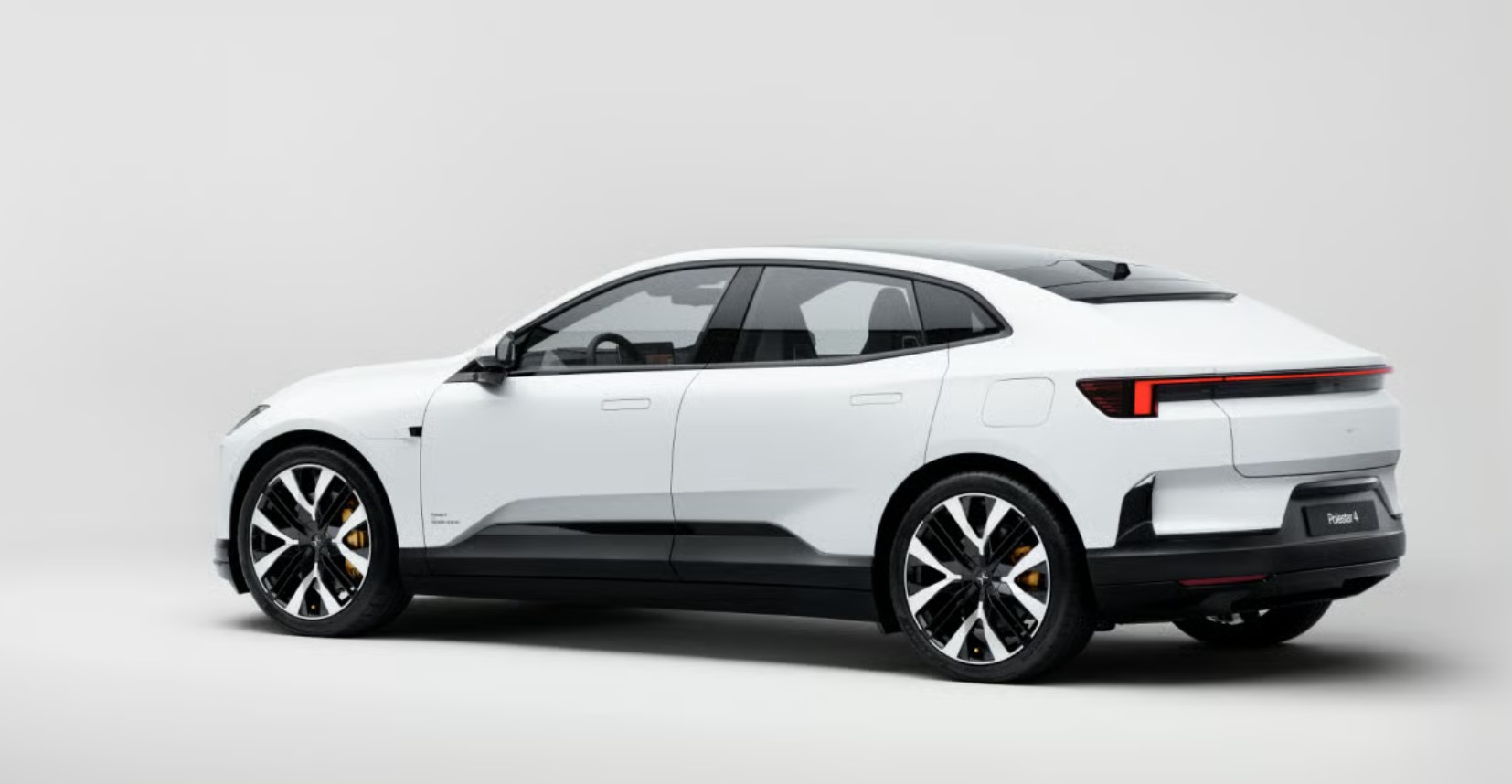
The Polestar 4 is one of the most audacious electric vehicles on the road today. Part SUV, part fastback sedan, entirely unconventional — it is the Swedish-Chinese automaker’s statement that premium electric mobility does not have to follow a formula. It ditches the rear windshield entirely, replaces it with a digital rearview mirror, extends the panoramic roof to the tail, and packs a 94-kWh battery capable of up to 310 miles of range. The result is a car that demands your attention on every level.
This guide covers everything you need to know about the Polestar 4: its performance figures, trim lineup, technology, sustainability credentials, and how it compares to the competition. Whether you are actively considering a purchase or simply curious about what Polestar is building, this is where to start.
What Exactly Is the Polestar 4?
Polestar names its vehicles in chronological order of launch — not by size — which means the 4 sits illogically between the smaller Polestar 2 fastback and the larger Polestar 3 SUV. Built on Geely’s Sustainable Experience Architecture (SEA) platform, the Polestar 4 stretches 190.5 inches in length on a 118-inch wheelbase, making it a spacious five-seater despite its coupe-like silhouette.
Think of it as Polestar’s answer to the Tesla Model Y, Genesis GV60, and the Porsche Macan EV. It competes on performance, technology, and design — and in several respects, it surpasses them all.
Performance and Powertrain
The Polestar 4 is offered in two powertrain configurations, both drawing from a 94-kWh battery pack.
The Long-Range Single Motor delivers 272 horsepower to the rear wheels, with a 0–60 mph time of 6.9 seconds and an EPA-estimated range of up to 310 miles. It is the pragmatist’s choice — more efficient, longer-range, and still impressively quick for everyday driving.
Step up to the Long-Range Dual Motor and the transformation is dramatic. Output leaps to 544 horsepower with 506 lb-ft of torque, enough to send the Polestar 4 to 60 mph in just 3.7 seconds, making it the quickest Polestar ever built. The dual-motor configuration adds all-wheel drive and supports DC fast charging at up to 200 kW, meaning real-world charging stops are genuinely brief.
Key Performance Figures at a Glance:
- Single Motor: 272 hp | 6.9 sec 0–60 | up to 310 miles range
- Dual Motor: 544 hp | 3.7 sec 0–60 | up to 272–300 miles range (varies by pack)
- DC Fast Charging: up to 200 kW
Trim Levels and Pricing
Polestar structures its lineup around four “Packs” — Pilot, Pro, Plus, and Performance — rather than traditional named trims. Here is how pricing breaks down for the 2025 model year in the United States:
| Configuration | Pack | Starting Price |
|---|---|---|
| Single Motor (RWD) | Base | $56,300 |
| Single Motor (RWD) | Plus Pack | $61,800 |
| Dual Motor (AWD) | Base | $64,300 |
| Dual Motor (AWD) | Plus Pack | $69,800 |
| Dual Motor (AWD) | Performance Pack | $74,300 |
Every Polestar 4 ships with a strong standard equipment list: 20-inch alloy wheels, a panoramic glass roof, a heat pump, power front seats, wireless smartphone charging, a surround-view camera system with 3D view, and a 10.2-inch digital instrument cluster paired with a 15.4-inch touchscreen powered by Google Built-in (with wireless Apple CarPlay also available).
The Plus Pack is arguably the sweet spot, adding synthetic leather upholstery, a head-up display, 12-way power front seats. Heated and reclining rear seats, a rear entertainment screen, a Harman Kardon sound system, and an upgraded 11-kW onboard charger. The Performance Pack, exclusive to the dual-motor model, brings Brembo brakes, 22-inch forged wheels on Pirelli P Zero summer tires, stiffer dampers, and Polestar’s signature “Swedish gold” accents on the brake calipers, valve caps, and seatbelts.
Design: The Rear Windshield That Isn’t There
The most polarising design decision Polestar has ever made is not the coupe roofline or the bold proportions — it is the complete absence of a rear windshield. The panoramic sunroof extends all the way to the tail, flooding the rear cabin with light, while a live-feed digital rearview mirror handles what glass used to.
The payoff is extraordinary. Rear passengers sit under a sweeping glass ceiling rather than a cramped roofline, and the exterior silhouette is unlike anything else in the segment. Most reviewers report adapting to the digital mirror quickly, with some coming to prefer it over conventional glass entirely.
Interior, Technology, and Sustainability
Inside, the Polestar 4 feels precisely like a premium Swedish EV should: calm, well-considered, and thoughtfully assembled. The 15.4-inch central touchscreen is crisp, with bold colours and clean typography. Google Built-in provides native Maps, the Google Assistant, and over-the-air app updates. While the optional Pilot Assist system manages lane-keeping, lane changes, and adaptive speed control — a capable Level 2 semi-autonomous driving system.
Sustainability is embedded in the cabin at a systemic level, not just a surface one. The standard interior uses bio-attributed MicroTech, a 100% vegan leather alternative. Other available upholstery options include tailored knit textile woven from recycled PET bottles and responsibly sourced perforated Nappa leather. Cabin materials are cut to near-zero-offcut precision, reducing production waste from the very first stitch.
How Does It Compare to the Competition?
The Polestar 4’s primary rivals in the premium electric segment are the Tesla Model Y, the Genesis GV60, and the Porsche Macan EV.
Against the Model Y, the Polestar 4 offers a more premium interior. Stronger build quality, and a far more distinctive design personality — though Tesla’s Supercharger network still gives it a real-world convenience advantage. Against the GV60, the Polestar 4 matches it on range and surpasses it in dual-motor performance Against the Macan EV. The 4 is meaningfully more affordable, especially in Plus Pack configuration. While delivering comparable interior technology and a more spacious rear cabin.
In Europe, it also competes directly with the BMW iX2 and Audi Q6 e-tron — two segment-defining rivals against which the Polestar 4’s distinctive identity and competitive efficiency figures have earned it genuine respect since its UK launch.
Who Should Buy the Polestar 4?
The Polestar 4 suits buyers who want more than competent transportation — those who want their daily driver to reflect considered values and make a genuine design statement. If you prioritise originality, real-world range above 300 miles, class-leading cabin technology, and meaningful sustainability credentials. The Polestar 4 belongs on your shortlist.
The Plus Pack on the single-motor model at $61,800 represents the strongest value in the lineup. Efficient, well-equipped, and refined enough to live with every day without compromise.
It is not without flaws. The ride can feel firm on base suspension, the digital mirror takes adjustment, and there is no proprietary fast-charging network to fall back on. But very few cars at this price point are more interesting — or more honest about what an electric vehicle can aspire to be.
The Verdict
The Polestar 4 is bold, considered, and unapologetically different. It offers up to 310 miles of range, 544 hp in dual-motor form. A deeply integrated Google-powered technology stack, vegan-forward interior materials, and a no-rear-windshield design that has no equivalent in the segment. Starting at $56,300 with strong standard equipment. It is a genuinely compelling alternative in the crowded premium EV market — and one of the more memorable cars of its generation.
