

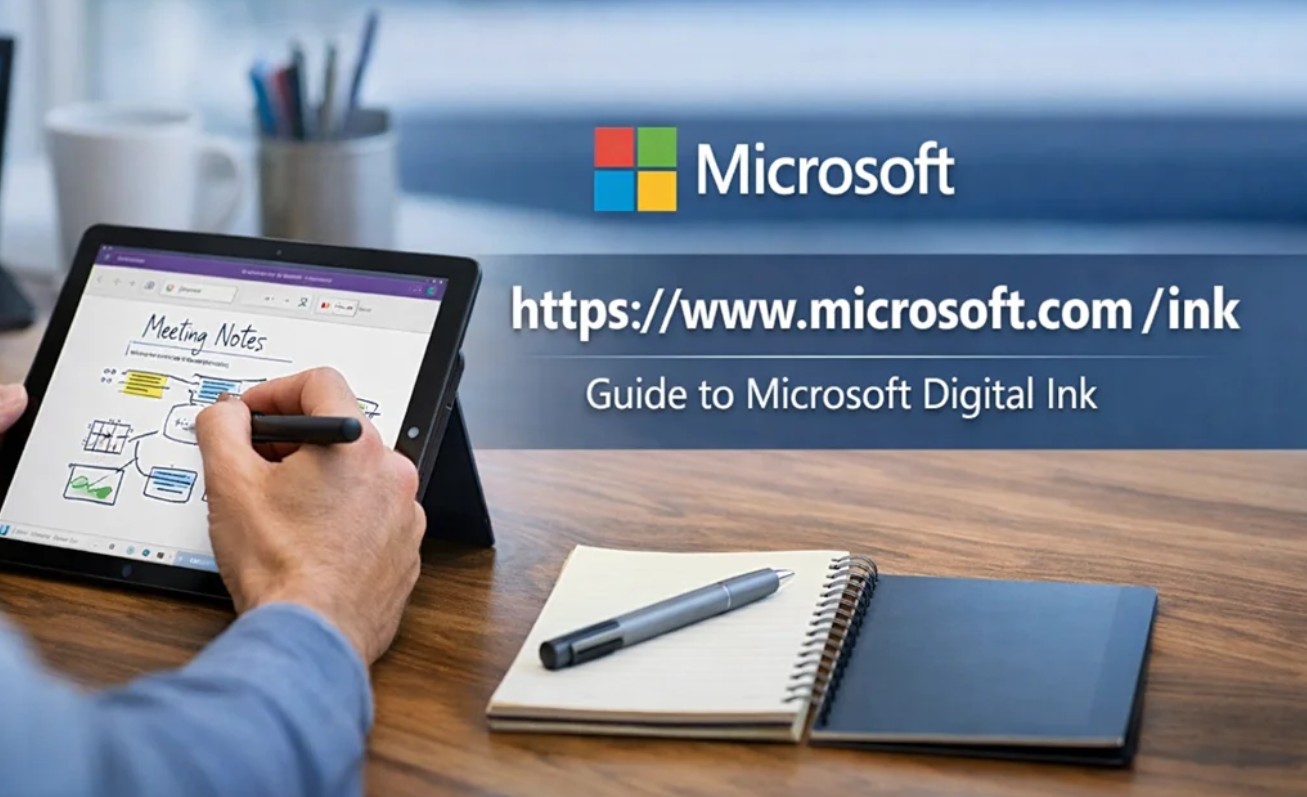
If you’ve typed https //www.microsoft.com /ink into your browser and landed on a page about digital pens rather than a software download, you are exactly where you need to be. That URL is Microsoft’s official information hub for Windows Ink — a powerful, built-in pen computing platform that ships with every copy of Windows 10 and Windows 11. This guide explains what it is, what it does, and how you can use it to work, learn, and create more effectively.
What Is https //www.microsoft.com /ink?
The address https //www.microsoft.com /ink points to Microsoft’s landing page for the Windows Ink ecosystem — the company’s end-to-end digital handwriting and stylus input platform. Windows Ink is not a separate application you install. It is a core layer built directly into the Windows operating system that handles everything from pen strokes and pressure sensitivity to handwriting recognition and cross-app annotation.
points to Microsoft’s landing page for the Windows Ink ecosystem — the company’s end-to-end digital handwriting and stylus input platform. Windows Ink is not a separate application you install; it is a core layer built directly into the Windows operating system that handles everything from pen strokes and pressure sensitivity to handwriting recognition and cross-app annotation.
Windows Ink is a pen computing layer already built into Windows 10 and Windows 11 that handles ink strokes, handwriting recognition, and stylus input from a digital pen or touchscreen. In short, when you pick up a stylus on a Surface Pro, a Dell XPS 13 2-in-1, or any compatible Lenovo ThinkPad, Windows Ink is the engine powering your experience.
The Windows Ink Workspace: Your Control Center
The most visible entry point into the Windows Ink ecosystem is the Windows Ink Workspace. Windows Ink Workspace is the quick-access control center for inking features. It can be opened from the taskbar or by pressing a pen button on supported devices.
With Windows 11, Ink Workspace was redesigned with a modern Fluent UI, rounded corners, and full customization support. Users can now pin any app to the workspace — not just pen-optimized ones. This is a meaningful upgrade from earlier versions, which limited the pinned shortcuts to a short, fixed list.
Inside the Workspace, three tools are immediately useful:
Sticky Notes — Sticky Notes lets you jot ideas quickly using your pen. It supports handwriting recognition, OCR, and Cortana integration for smart suggestions based on what you write. You can write a flight number and get live flight status, or write a phone number and call it directly. It turns quick ink notes into actionable digital content.
Sketchpad — Sketchpad is a blank digital canvas inside the Windows Ink Workspace. It is perfect for quick sketches, mind maps, or rough diagrams when you need to capture an idea fast. It works entirely with your pen and supports all pressure levels.
Screen Sketch / Snipping Tool Screen Sketch lets you capture your screen and annotate it instantly using your pen. In Windows 11, this has been folded into the updated Snipping Tool. You can draw arrows, circle elements, write text, or highlight areas directly on any screenshot.This makes it invaluable for remote collaboration and visual documentation.
Core Features of Microsoft Ink
Handwriting Recognition and Ink-to-Text Conversion
One of the most transformative capabilities Microsoft Ink offers is real-time handwriting-to-text conversion. In 2026, Windows’ handwriting recognition uses advanced AI to learn your style. Open any text field and start writing with your pen — it converts your handwriting to typed text in real-time. You can use the Ink Editor in Word to write naturally, then use simple gestures like circling text to select it, striking through words to delete them, or drawing a caret to insert new content.
Microsoft Ink includes handwriting-to-text conversion across Windows and Microsoft 365. AI-powered recognition through Azure Cognitive Services handles complex text, shapes, and equations.
Pressure Sensitivity and Natural Pen Feel
Microsoft Ink responds to how hard you press with your pen. Light pressure creates thin lines; heavier pressure creates thicker, bolder strokes. This pressure sensitivity — combined with tilt detection and stroke speed awareness. Creates a writing experience that closely mirrors putting pen to paper.
The Ink Toolbar
When you’re in a drawing-capable app, the Ink Toolbar appears with a floating palette of pens, highlighters, erasers, and rulers. Use the virtual ruler to guide your pen for perfectly straight lines, or the protractor to draw precise arcs and angles.
Ink to Math
For students and professionals working with equations, Ink to Math is a standout feature. Ink to Math converts handwritten equations into formatted math expressions. All three ink conversion tools work inside Microsoft 365 apps with quality that has improved significantly with newer Windows builds.
Microsoft Ink Across Microsoft 365
As a core part of the Windows Ink Workspace, Microsoft Ink enhances productivity across Office 365 tools such as Microsoft Word, Excel, PowerPoint, and OneNote. It bridges the gap between traditional and digital writing, allowing students, professionals, and creative users to capture ideas effortlessly and collaborate in real-time.
Every inking feature in Office lives under the Draw tab. If you don’t see it, go to File > Options > Customize Ribbon and enable it. From there you get access to pens, highlighters, erasers, and inking tools. If the Draw tab appears grayed out, the document is likely in Protected View or Compatibility Mode — exiting those modes restores full ink functionality.
Setting Up Microsoft Ink on Your Device
Getting started is straightforward:
- Check compatibility — Microsoft Ink works best on devices with active pens, like the Microsoft Surface Pro. Surface Laptop Studio, and a wide range of partner devices from Dell, HP, Lenovo, and others.
- Pair your pen — If your stylus uses Bluetooth (like the Surface Slim Pen), pair it via Settings > Bluetooth & Devices > Add Device.
- Calibrate for precision — Navigate to Settings > Bluetooth & Devices > Pen & Windows Ink to adjust pen pressure sensitivity to your personal writing style.
- Customize the Workspace — Pin up to four preferred apps so your most-used inking tools are always one tap away.
What’s New in 2025 and 2026
In 2026, major additions include haptic feedback on Surface Slim Pen 2. AI-powered ink recognition via Copilot, improved shape and table detection in OneNote, and real-time ink collaboration in Microsoft Teams. These additions reflect Microsoft’s broader push to make natural pen input a first-class experience rather than an afterthought.
As we progress through 2026, Windows Ink continues evolving with new AI-powered features. Improved handwriting recognition using machine learning, enhanced collaboration tools for hybrid work environments, and deeper integration with Microsoft 365 applications.
Who Should Use Microsoft Ink?
Students benefit from handwriting-to-text conversion and annotating lecture slides directly in OneNote or PowerPoint. Professionals gain the ability to mark up PDFs, sketch diagrams in real meetings, and annotate documents without switching tools. Creatives access a full suite of pressure-sensitive brushes and drawing tools. Educators can annotate, demonstrate, and highlight content in real time during digital lessons.
Final Verdict
https //www.microsoft.com /ink is the gateway to one of the most deeply integrated digital pen experiences available on any desktop operating system. Whether you’re annotating a report in Word, sketching in Whiteboard, converting handwritten equations in Excel. Or capturing a quick screenshot note, Windows Ink brings natural. Intuitive input to every corner of the Windows and Microsoft 365 ecosystem — and with AI now powering recognition and suggestions, it’s more capable than ever.
If you own a pen-compatible Windows device and haven’t explored what’s behind that URL, you’re leaving a significant amount of productivity on the table.
