

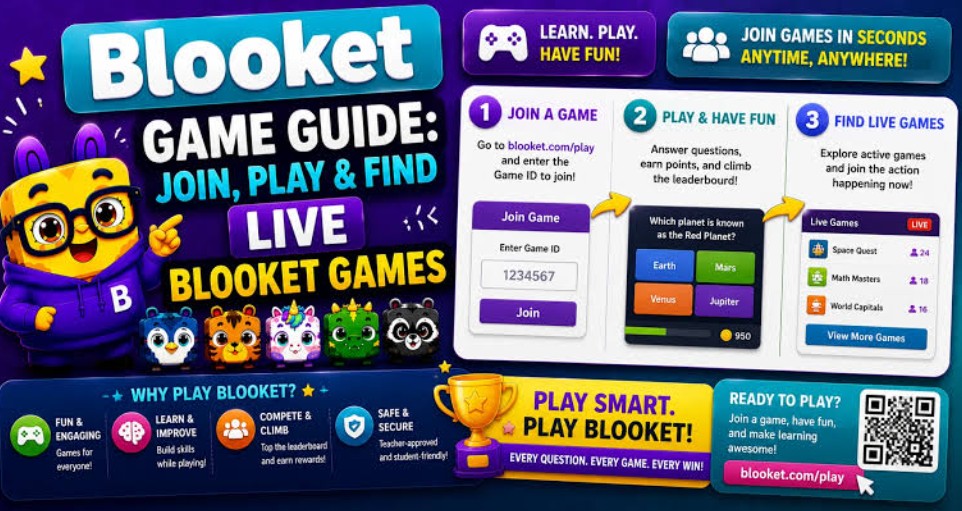
So you typed “bloket play” into Google. Fair enough — it’s one of the most common ways people search for this, right alongside “bloket join” and “play bloket.” Here’s the thing though: the actual name is Blooket, with two O’s. Easy mistake, everyone makes it at some point, especially if you first heard about it verbally from a teacher or a friend instead of seeing it written down.
I’ve used this platform a fair amount, both watching it get used in classrooms and messing around with it myself, and I figured I’d just lay out what it is, how joining and hosting actually works, and what trips people up.
Okay, But What Is It
Blooket is basically a quiz turned into a game. A teacher (or really anyone) builds a set of questions, then hosts a live round where students join in and answer those questions, except instead of it feeling like a test, it’s wrapped in something that plays more like a mini video game. Some modes are like a race. Some are like a tower defense game. One’s basically a café-management thing where correct answers earn you resources. The quiz content is the same underneath, but the packaging changes everything about how it feels to sit through it.
That’s really the whole appeal. Kids will groan at a worksheet and then get genuinely competitive over the exact same 20 questions if there’s a leaderboard and some cartoon characters involved.
Joining a Game (the “bloket join” part)
If someone gave you a code, this part takes maybe 30 seconds:
You go to the play page — make sure it’s the real one, not some random copycat site that shows up in search results and slaps ads all over it. Type in the code your teacher gave you, exactly as written. This trips people up more than you’d think; one wrong digit and it just won’t let you in.
Pick a nickname. You don’t need an account for this part — you can join as a guest and just play. Having an account does let you keep your points and your character between games, so if you’re a regular user it’s worth setting one up, but it’s not required to just hop into a session.
Then you sit in the lobby until the host starts things. That’s it.
If the code isn’t working, first double check you typed it right (obvious, but it’s the actual cause 90% of the time), then try refreshing.
The Dashboard (this is where “bloket dashboard” comes in)
Once you log in, you land on your dashboard, and this is really the control room for everything. It looks a little different for teachers versus students, but the pieces are roughly:
Your own sets live under something like “My Sets” — this is where you build questions from scratch or edit ones you’ve already made. They’re private by default, so nobody sees your stuff unless you choose to share it.
There’s a Discover section with a genuinely huge library of sets other people have already built. If you don’t feel like writing 20 questions about photosynthesis yourself, chances are someone already has, and it’s searchable by subject and grade level.
Hosting lives in its own spot — pick a set, pick a game mode, tweak the settings (time limits, how many players, that sort of thing), and it spits out a code for you to share.
There’s also a stats/history area, which honestly is more useful than people give it credit for. After a game ends you can see exactly which questions gave everyone the most trouble, which is a pretty direct way to figure out what to go over again next class.
Why People Actually Stick With This
I think the reason this hasn’t faded out like a lot of “gamified learning” tools is that it doesn’t punish you for going slow. A lot of these platforms reward pure speed, which just means the fastest kid wins every time and everyone else checks out. Blooket weights accuracy pretty heavily in most modes, so thinking it through actually matters.
There’s also a separate reward loop — tokens you earn just from playing, which you spend on unlocking characters.
And it just works everywhere. Browser-based, no app, runs fine on a school Chromebook or a phone.
Things That Go Wrong (and how to fix them)
“Invalid code” — almost always a typo, or the game already ended. Ask the host to double-check or start a new one.
Page freezing or lagging — try a different browser before assuming something’s broken. Chrome acting up? Try Firefox or Edge. Switching from school wifi to your own data sometimes fixes it too.
Annoying, but that’s how it works, so just keep the tab open.
Free vs. paid confusion — the free plan covers what most people need. There’s a paid tier for teachers who want deeper stats or more game mode options, but plenty of classrooms never touch it and don’t need to.
One Last Thing
If you got here by searching “bloket” instead of “Blooket,” you’re genuinely not the only one — it’s a super common typo, kind of like how everyone’s typed “gogle” at least once. Now you know the right spelling, which’ll get you cleaner search results and keep you off knockoff sites pretending to be the real thing.
Beyond that, honestly the best way to get comfortable with it is to just poke around — make an account, look through a few sets, host a low-pressure game with friends or a small group before using it for something that actually matters. It’s pretty intuitive once you’ve clicked through it once.
