

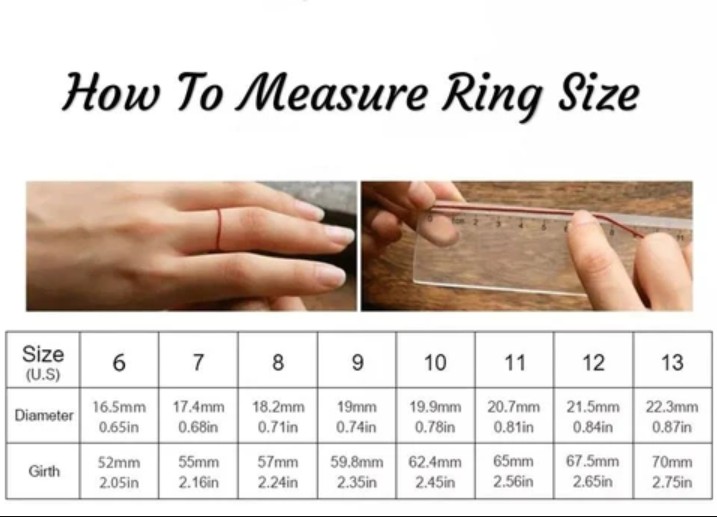
So you need to figure out your ring size. Maybe you’re buying something online. Maybe it’s a surprise gift and you can’t exactly ask. Either way, you’re here because guessing feels risky — and honestly, it is.
A ring that’s even half a size off can go from slightly annoying to genuinely uncomfortable by the end of the day. And getting it resized? That costs money, takes time, and for some materials — tungsten, titanium, ceramic — it’s flat out not possible.
The good news is you don’t need to walk into a jewelry store to get this right. Here’s what actually works.
Method 1: Paper Strip (The Classic)
Grab a thin strip of paper — nothing fancy, just tear one off from any sheet. Wrap it around the base of the finger. Snug, but not cutting in. Mark where it overlaps, then lay it flat on a ruler. Measure in millimeters. Done.
That number is your circumference. 52 mm puts you at roughly a US size 6. Around 57 mm? You’re closer to an 8.
Here’s the part most people skip: do NOT measure in the morning. Fingers are noticeably slimmer when it’s cold or when you’ve just woken up. Measure in the evening, after your body’s been active for a few hours. That’s when your fingers are at their actual, everyday size.
Method 2: Use a Ring That Already Fits
Already have a ring that fits the right finger? Perfect — this is faster and honestly more reliable than the paper method.
Lay it flat on a ruler. Measure the inside diameter (that’s the gap across the hollow part, not the outer edge). In millimeters.
16.5 mm = US size 6. 18.2 mm = size 8.
If you’re buying a surprise gift, this is gold. Borrow one of their rings for literally 60 seconds, measure it, return it. They’ll never know. You can also place it on a printed size chart from any jeweler’s website — just print at 100% scale, not “fit to page,” or the circles will be slightly off and throw your whole reading.
Method 3: Printable Ring Sizer
Free on almost every major jewelry brand’s website. You print the page, cut out the strip, wrap it around your finger, and read the size where it lines up on the scale printed right on the paper.
It sounds too simple, but it genuinely works — when done right.
The mistake people make: printing with “fit to page” turned on. That option scales the document slightly to fill the paper, which means every circle and every measurement is just a tiny bit wrong. Before you trust the printout, grab a ruler and check the reference bar on the page. It’ll say something like “measure this line — it should be exactly 1 inch.” If it isn’t, reprint.
Method 4: Ring Sizing App
A few jewelry brands have built apps that use your phone camera and a reference coin to measure ring diameter. You put a coin (any coin with a known diameter works) next to your ring on a flat white surface, open the app, and it calculates the size.
Accurate? Usually within half a size, which is good enough for most purchases. Where it falls apart is bad lighting, a tilted camera, or skipping the calibration step at the start. If the app asks you to calibrate first — do it. That step is the whole reason it works.
Method 5: Get Professionally Sized Once
Yes, this technically involves leaving the house. But hear me out.
Getting sized at a jeweler takes about 30 seconds, costs nothing, and gives you a number you can use forever. They use a ring mandrel — basically a tapered metal rod with sizes marked on it — and slip a few rings on your finger until one fits right. That’s it.
Once you have that baseline, every at-home method becomes a quick confirmation rather than a guess. Worth doing at least once.
Why Your Ring Size Isn’t Always the Same Number
This part’s important and most guides either skim over it or skip it entirely.
Your fingers change size. Not dramatically, but enough to matter when you’re shopping for rings.
Temperature is the biggest factor. Cold hands are smaller. Hot, swollen summer hands are bigger. If you measure during winter and then wear the ring through July, it may feel tight. Measure at room temperature, not right after coming in from the cold.
Morning versus evening also makes a real difference. Fluid collects in your body’s extremities throughout the day. By evening, your fingers are measurably larger than they were at 7am. For most people it’s a small difference — but in ring sizing, small matters.
Weight fluctuations affect it too. If you’ve put on or lost a meaningful amount of weight recently, a ring from two years ago isn’t a reliable reference anymore.
Pregnancy is a big one. Fingers can swell significantly, especially in the second and third trimesters. Best to wait until things have settled post-delivery before buying fitted rings.
And one people always forget — your dominant hand is larger. Usually by about half a size. If you’re measuring for your right hand, measure your right hand. Don’t assume it matches the left.
Knuckles are the other thing. Some people have knuckles that are noticeably wider than the base of their finger. If that’s you, you need the ring to fit over the knuckle, which means sizing up — and then potentially using a small sizing insert so it doesn’t spin around once it’s past the knuckle.
Quick Size Reference
| US Size | Inner Diameter | Circumference |
|---|---|---|
| 5 | 15.7 mm | 49.3 mm |
| 6 | 16.5 mm | 51.9 mm |
| 7 | 17.3 mm | 54.4 mm |
| 8 | 18.2 mm | 57.2 mm |
| 9 | 19.0 mm | 59.5 mm |
| 10 | 19.8 mm | 62.1 mm |
UK, EU, and Australian sizes use the same inner diameter — you just map it to a different scale. Any jeweler’s site will have the full conversion chart.
Before You Hit Order
Measure more than once. Three times if you can. Take the average. A single reading can be off if you wrapped the paper slightly too tight or marked it at an angle.
Stuck between two sizes? Go bigger. Sizing a ring down is straightforward for a jeweler. Making it larger is harder and sometimes not possible.
Wide bands — anything 6 mm or more — fit tighter than thin ones, even at the same diameter. If you’re buying a chunky band, go up half a size.
And if you’re buying a gift: check inside the rings they already wear. Gold and silver rings often have the size stamped right there on the inner band. Saves you the whole measuring process.
That’s Really It
Knowing how to measure ring size at home isn’t complicated once you understand where people go wrong. Measure in the evening. Don’t trust morning readings. Print at 100% scale. And when in doubt — size up, not down.
A well-fitting ring disappears on your finger. You stop noticing it. That’s exactly how it should feel.
