

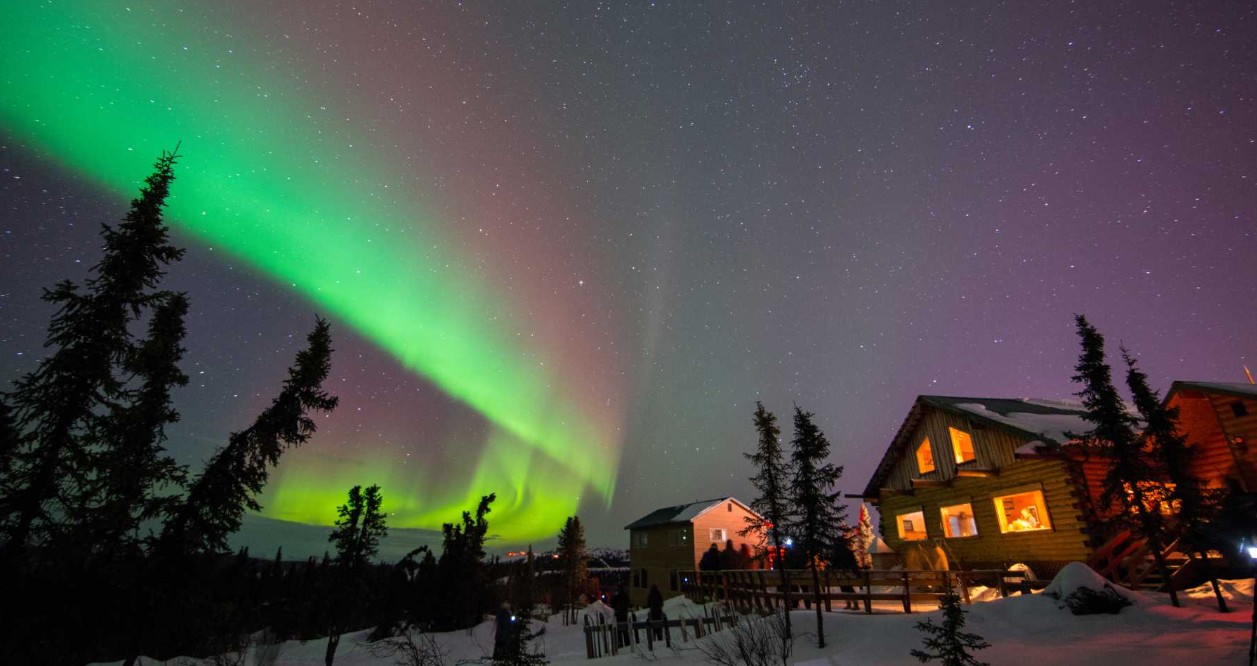
Few experiences on Earth rival standing beneath a sky that has suddenly caught fire in ribbons of green, violet, and deep crimson. Alaska does not merely offer a chance to see the northern lights it delivers one of the most reliable, accessible, and spectacular aurora experiences on the planet. If seeing the aurora borealis is on your bucket list, Alaska belongs at the top of that conversation. This guide breaks down the best places to see aurora in Alaska, what makes each one special. The practical knowledge you need to actually witness the lights rather than just hope for them.
Why Alaska Is One of the Best Places on Earth for Aurora Viewing
Alaska sits directly beneath the auroral oval a ring-shaped zone centered near the geomagnetic north pole where aurora activity is most concentrated. This geographic reality means that on a clear night. Alaska’s Interior and Arctic regions do not just have a chance of seeing the aurora; they often have the lights dancing directly overhead, not dimly on the horizon.
The aurora occurs when electrically charged particles from the sun travel through Earth’s magnetosphere and collide with atmospheric gases, releasing energy as waves of colored light. The most common display is a vivid green, though red and purple appear during stronger solar events. Alaska’s long, dark winters combined with minimal light pollution in most of the state create near-perfect conditions from late August through late April.
One more piece of good news for anyone planning a trip in 2025 or 2026. The current solar cycle reached its peak around 2024–2025, and aurora activity remains elevated well into 2026. Displays are more frequent, more colorful, and visible across a wider area than in quieter years. Timing a trip now is genuinely excellent aurora strategy.
The Best Places to See Aurora in Alaska
1. Fairbanks The Aurora Capital of the United States
If there is one city built for aurora watching, it is Fairbanks. Sitting directly under the auroral oval at roughly 65 degrees north latitude, Fairbanks offers a remarkable statistic. Visitors who spend just three nights here during aurora season have about a 90% chance of seeing the lights.
The city has an entire ecosystem of aurora infrastructure. Tour operators run nightly excursions to dark-sky locations. Remote lodges outside town offer heated cabins with picture windows facing the sky. Some hotels even offer aurora wake-up calls, alerting guests the moment the lights appear.
Cleary Summit, located about 20 miles north of Fairbanks, is one of the most popular local viewing spots a high. Open ridge with 360-degree visibility that is ideal for both seeing and photographing the aurora.
For aurora forecasting, the University of Alaska Fairbanks Geophysical Institute publishes nightly forecasts and a 27-day outlook that serious aurora chasers should bookmark before and during any trip.
2. Chena Hot Springs Resort Soak Under the Stars
About 60 miles northeast of Fairbanks, Chena Hot Springs Resort is one of Alaska’s most beloved aurora destinations and for understandable reasons. The resort sits beneath the auroral oval, far from city light pollution, with clear views of the sky in every direction.
What makes Chena genuinely unforgettable is the combination of warm geothermal water and cold arctic air. Guests soak in open-air hot springs pools while the aurora erupts above them, the contrast between the warm water and the luminous sky producing a sensory experience that is nearly impossible to describe in ordinary language. For photographers, the steam rising off the pools creates a natural foreground element that produces exceptional images.
The resort also offers guided aurora viewing from Charlie Dome, a high-altitude vantage point with an unobstructed 360-degree horizon.
3. Coldfoot and Wiseman The Arctic Circle Experience
For travelers who want to go deeper into Alaska’s wilderness, the small communities of Coldfoot and Wiseman located on the Dalton Highway about 250 miles north of Fairbanks and well above the Arctic Circle represent some of the most reliable aurora viewing anywhere on Earth.
Coldfoot is positioned directly in the center of the aurora oval, which means even on nights when activity is moderate elsewhere, the lights can appear clearly here. One tour operator puts it simply: if the skies are clear and the lights are active, you are going to see them in Coldfoot.
Wiseman, just 15 miles north of Coldfoot, is a tiny community of fewer than 25 residents set against the Brooks Range. The combination of mountain scenery, near-zero light pollution, and overhead auroral activity makes it one of the most photogenic aurora locations in the world. Tours from Fairbanks typically travel up the famous Dalton Highway, cross the Arctic Circle, and include an evening visit to a historic Wiseman cabin for aurora watching.
4. Denali National Park Aurora Over North America’s Highest Peak
Denali National Park offers something the other locations cannot: the possibility of watching the northern lights with Denali the tallest mountain in North America at 20,310 feet rising in the background. The park’s minimal light pollution and sweeping, treeless tundra provide wide, unobstructed views of the sky.
The gateway community of Cantwell and the area around the park entrance are popular bases for aurora viewing. September, when the tundra is still glowing with autumn color and true night has just returned to the Interior, is a particularly magical time to visit.
5. Anchorage and the Mat-Su Valley Accessible Viewing for City-Based Travelers
Anchorage may be Alaska’s largest city, but aurora viewing is genuinely possible here especially during periods of higher solar activity. The Glen Alps Trailhead, a high-elevation parking area in the Chugach Mountains just 20 minutes from downtown, offers excellent sky exposure with the city lights falling away below.
Point Woronzof, a coastal area near the international airport, has strong northern exposure along Cook Inlet and is another reliable local option. Farther out, the Knik River Valley and Beluga Point on the Seward Highway provide darker skies with expansive horizon views.
For a more dedicated experience, the alpine terrain of Hatcher Pass in the Mat-Su Valley sitting at around 3,500 feet elevation combines mountain scenery with genuine dark skies.
Practical Tips for Seeing the Aurora in Alaska
Plan for at least three nights. The aurora is a natural phenomenon, not a scheduled event. Cloud cover, timing, and solar conditions all vary. More nights means more chances.
Go out between 10 pm and 2 am. This is the window when aurora activity is most frequently concentrated.
Get away from city lights. Even moderate light pollution softens the display significantly. A 20-minute drive from almost any Alaskan town can make a dramatic difference in what you see.
Dress for serious cold. Aurora season runs from late August to late April. January and February nights in Fairbanks regularly drop below -20°F. Layering matters enormously think insulated base layers, a wind-proof outer shell, and hand warmers.
Use aurora forecast tools. The University of Alaska Fairbanks Geophysical Institute provides the most locally trusted forecasts. The Kp index a scale from 0 to 9 measuring geomagnetic activity is useful context: in Fairbanks, you can see aurora at Kp 2 or 3. In Anchorage, you typically need Kp 4 or higher.
Consider a guided tour. Experienced local guides know exactly where the skies are clearest on any given night, can reposition quickly. Often have heated viewing stations that make a long, cold wait into a comfortable adventure.
Final Thoughts
Alaska is not simply a good place to see the northern lights it is one of the best places on Earth to experience them, with infrastructure, geography, and aurora science all working in the traveler’s favor. Whether you choose the convenience of Fairbanks, the drama of Chena Hot Springs, the raw wilderness of the Arctic Circle, or the grandeur of Denali as your backdrop, the best places to see aurora in Alaska are exactly what they appear to be: world-class destinations for one of the most breathtaking natural wonders the planet offers.
