
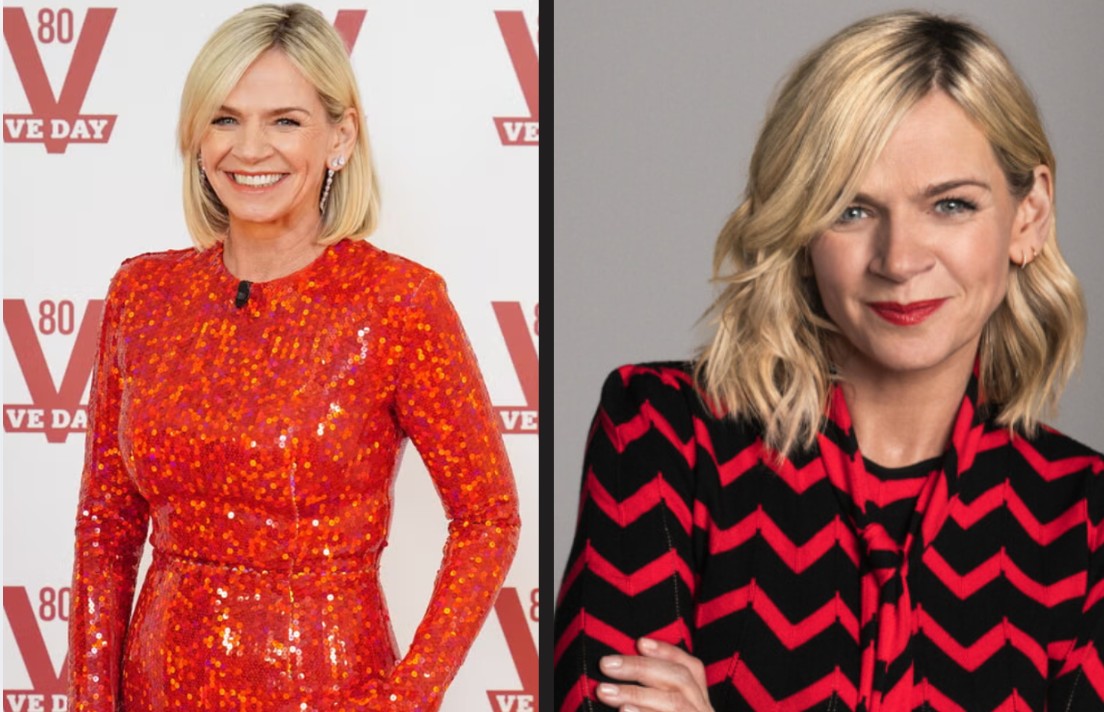
She has woken up millions of people every morning, made history not once but twice, and stepped away from the most coveted slot in British radio on her own terms. Zoe Ball is not simply a broadcaster — she is a cultural institution. From the anarchic energy of 1990s Radio 1 to the warm, living-room intimacy of her podcast with Jo Whiley, Ball has done something few in the entertainment industry manage: she has stayed relevant across three decades without ever losing what makes her genuinely compelling.
Who Is Zoe Ball?
Zoe Louise Ball was born on 23 November 1970 in Blackpool, Lancashire, the daughter of beloved children’s television presenter Johnny Ball. Growing up in the entertainment world gave her an early education in the mechanics of storytelling and audience connection — lessons she clearly absorbed. After studying radio and journalism at Amersham College of Art and Technology, she began her career the old-fashioned way: as a runner at Granada Television, working her way up through children’s programming, including Playdays, SMart, and the wildly popular Saturday morning show Live & Kicking, which she co-hosted alongside Jamie Theakston from 1996 to 1999.
Those early years mattered. They gave Ball something that no amount of fame can manufacture — experience in front of a real audience, the ability to read a room, and the instinct to make people feel included rather than merely entertained.
A History-Making Radio Career
In October 1997, Zoe Ball made history by becoming the first female host of the BBC Radio 1 Breakfast Show, taking over one of the most iconic slots in British broadcasting during the height of the Britpop era. The timing could not have been more electric. The country was alive with cultural confidence, and Ball brought exactly the right energy to match it. She was young, charismatic, unfiltered, and unapologetically herself — qualities that earned her enormous audiences but also led the BBC to issue two warnings for on-air swearing. The tabloids labelled her a “ladette,” a term she has since reflected on with characteristic good humour, acknowledging that while the era was genuinely exciting, some of the mythology around it was rather inflated.
Radio Career
Then came an even bigger moment. In January 2019, Ball stepped into the BBC Radio 2 Breakfast Show, replacing Chris Evans and again making history as the first woman to hold that position. It was a role she held for nearly six years, building a listenership of 6.3 million people at its peak and becoming the BBC’s second-highest-paid presenter, earning up to £950,000 a year at her highest. During the upheaval of the pandemic, when the early morning show became a lifeline for millions of people sitting alone in lockdown, Ball’s natural warmth and steadiness proved exactly what audiences needed. She has spoken about that period as one of the most meaningful of her career — a reminder of why radio, at its best, is one of the most human things broadcasting can offer.
In December 2024, Ball announced she was stepping down from the Breakfast Show, with Scott Mills named as her successor. She remained at Radio 2 briefly, launching a Saturday afternoon show in May 2025, before stepping back from that slot too in December 2025, with Emma Willis taking over.
Television, Strictly, and a Decade on It Takes Two
Ball’s television career has run parallel to her radio success rather than in competition with it. Alongside her children’s presenting work in the 1990s, she appeared as a contestant on the third series of Strictly Come Dancing in 2005, partnered with Ian Waite, and the pair earned 38 out of 40 for three dances — a performance that showed she was more than willing to throw herself into something difficult and public.
In 2011, she took over from Claudia Winkleman as the host of Strictly Come Dancing: It Takes Two on BBC Two, a role she held for a decade. The show suited her perfectly — conversational, warm, slightly chaotic in the best way. She left in May 2021. In May 2026, Ball openly discussed missing out on a main presenting role on Strictly Come Dancing itself, handling the rejection with the kind of honesty and self-awareness that has always set her apart from the more guarded corners of the entertainment world.
Personal Life, Loss, and Resilience
Zoe Ball’s personal life has been as public as her professional one, and she has handled that visibility with considerable grace. She married DJ and musician Norman Cook — known globally as Fatboy Slim — in August 1999. The couple separated in 2003 following an affair Ball publicly disclosed, but later reconciled. They have two children together: son Woody, now 25, and daughter Nelly, 16. The couple announced their separation again in September 2016 after 18 years together.
In 2017, Ball suffered a profound loss when her boyfriend, cameraman Billy Yates, died by suicide aged 40. She has spoken with unflinching honesty about grief and mental health since then, becoming a visible and credible advocate for mental health awareness in the UK. In 2018, she cycled 300 miles from Edinburgh to Brighton for Sport Relief, raising over £1.2 million — an achievement that said as much about her character as any broadcasting milestone. Since June 2025, she has been in a relationship with TV production designer Mathieu Weekes.
The Next Chapter: Dig It and Life Beyond the Breakfast Show
Rather than retreating after leaving Radio 2, Ball has moved into podcasting with evident enthusiasm. In July 2025, she launched Dig It alongside her long-time friend Jo Whiley, produced by the award-winning company Persephonica. The podcast releases new episodes every Monday and Wednesday, covering everything from family life and health to music, ageing, and gardening with a candour that polished radio rarely permits. The show has already built a substantial following on Spotify and YouTube, reflecting not just Ball’s existing audience but an appetite for the kind of honest, unscripted conversation that she and Whiley do naturally.
In May 2026, Ball also appeared on the BBC genealogy series Who Do You Think You Are?, exploring her family history alongside her father — a quietly moving contribution that reminded viewers of the depth behind the smile.
Why Zoe Ball Still Matters
What makes Zoe Ball endure is not nostalgia, though there is plenty of goodwill built up over thirty years. It is that she has always been genuinely present — with her audience, with her guests, with her own vulnerabilities. She does not perform accessibility; she simply is accessible. In an era when media personalities are increasingly managed and curated to the point of invisibility, that quality is rarer and more valuable than ever.
From a Blackpool childhood to the Radio 1 turntable, from the Strictly sofa to a podcast in her living room, Zoe Ball has never stopped growing. And that, more than any award or audience figure, is what makes her one of British broadcasting’s true greats.
